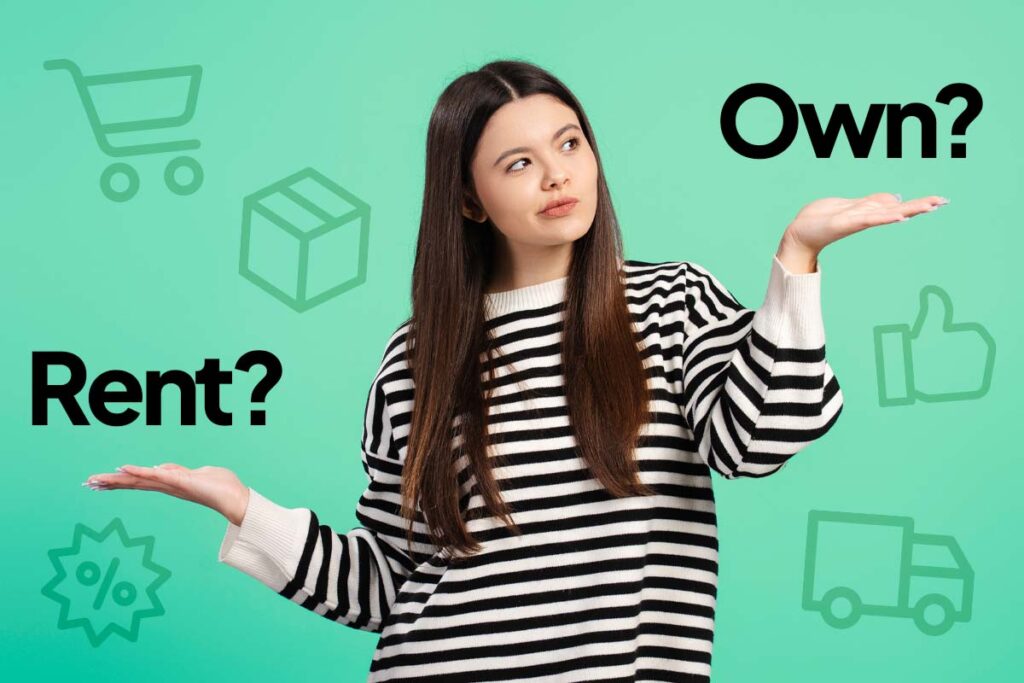
WooCommerce vs Shopify: 10 Reasons Growing Stores Choose to Own, Not Rent
 By Ian Fraser
Technical Lead & Founder, 89 Digital Over 25 years experience building websites and applications, a full stack Developer with a Graphic Design background. Ian works with businesses to build their website foundations fit to grow.
By Ian Fraser
Technical Lead & Founder, 89 Digital Over 25 years experience building websites and applications, a full stack Developer with a Graphic Design background. Ian works with businesses to build their website foundations fit to grow.
If you’re starting an online store, or wondering whether your current one still suits you, two names come up first: WooCommerce and Shopify. Both are capable platforms, and both run thousands of successful businesses across New Zealand and Australia.
So the real question isn’t which one is “better”. It’s which one suits the way your business works, and the way you want it to grow.
Shopify is built around convenience. It’s a hosted, all-in-one service that gets a store live quickly with very little to manage. WooCommerce takes a different approach. It’s open-source software that turns a WordPress website into a store, and it’s built around flexibility and ownership.
We work with WooCommerce stores every day, so we’re not neutral, but we’ll be fair. Here’s where that flexibility makes a real difference, and when Shopify might be the better choice for you.
10 reasons growing stores choose WooCommerce
- You own your store. You’re not renting it.
- Your data lives in your own database. Customers, orders and content are yours to keep, back up and use.
- You can move without rebuilding. Change hosts, developers or agencies and take the whole store with you.
- There’s no platform fee. WooCommerce is free, open source and takes no cut of your sales.
- You choose your payment gateway. Popular choices are Stripe, Paystation, Windcave and, new to the scene, Airwallex.
- You can build custom features. Tailored product options, trade pricing, subscriptions or private stores.
- You can shape the checkout. Add fields, change steps and set your own rules.
- You control your SEO. URLs, structured data, robots.txt, sitemaps and llms.txt are all in your hands.
- Content and products sit together. WordPress is a publishing platform first, so your guides and your products build authority together.
- It connects to the systems you already use. NZ and Australian couriers, Xero or MYOB, and your own systems.
Here’s more detail on the reasons that matter most.
1. Own your store instead of renting it
Shopify is a software-as-a-service (SaaS) platform. Like most SaaS products, you pay a monthly subscription, and your store runs on Shopify’s systems under Shopify’s terms. Put simply, you’re renting. It’s a well-run, convenient rental, however you still rent it and you don’t own the platform.
WooCommerce works differently. The software is free and open source, and your store runs on hosting you choose. That means the whole thing is yours: the code, the design, the products, the customer records and the order history.
In practice, that gives you a few useful freedoms:
- Choose your hosting. Pick a host in New Zealand or Australia, close to your customers, for local speed and support, or move to a bigger setup when you outgrow the first one.
- Keep your data close. Your customer and order data sits in your own database. You can back it up, export it or connect it to other systems whenever you like.
- Move without starting again. If you change developers, agencies or hosts, the store comes with you. Nothing has to be rebuilt.
The difference shows when you want to change direction. Leaving any SaaS platform takes work. Products, customers and orders can usually be exported, but the theme, apps and custom setup are built for that platform and stay behind, so a move often means a rebuild. A WooCommerce store moves to a new host in one piece.
For many business owners, that sense of control is the main reason to choose WooCommerce. Your store becomes a business asset you own outright, and it grows in value as you build on it.
That ownership has real value. Every dollar you put into a WooCommerce store, from custom features and design to content and years of customer history, builds an asset that belongs to your business. If you ever sell, the buyer gets the whole store and can run it anywhere, which makes it easier to value and simpler to hand over.
2. Build exactly what your business needs
Every business has its quirks. Maybe you sell made-to-order products with lots of options. Maybe you run trade and retail pricing side by side, or you need a private ordering portal for staff or members. Maybe your shipping rules depend on weight, size, region and product type all at once.
WooCommerce is built to be shaped around those quirks. Because the code is open, a developer can change almost any part of it:
- Product logic. Custom options, bundles, subscriptions, bookings, wholesale tiers or calculated pricing.
- Checkout. Add fields, change steps, set rules for who can buy what, or simplify the whole flow for repeat customers.
- Accounts and access. Members-only catalogues, approval-based trade accounts or private stores for one organisation.
- Design. No template limits. The store can look and behave exactly as your brand needs.
We’ve built a number of private merchandise stores on WooCommerce, each set up for a single organisation with its own rules for who can order what. That kind of tailored setup is where WooCommerce really shines.
There’s also a huge library of extensions for common needs, so you only write custom code where it adds real value.
3. Content, SEO and AI search are built in
WooCommerce runs on WordPress, which powers a large share of the world’s websites and was built for publishing first. That makes your store a strong content platform as well as a shop.
It matters because people rarely find a store through its product pages alone. They find it through buying guides, how-to articles, comparison pages and helpful answers. More and more, they also find it through AI tools like ChatGPT, Google’s AI Overviews and Perplexity, which draw on that kind of content.
With WooCommerce you get:
- Full control of technical SEO. URLs, page titles, meta descriptions, redirects, canonical tags and site structure.
- Rich structured data. Detailed product, review, FAQ and organisation schema that search engines and AI tools can read clearly.
- Blog and product in one place. Articles and products live on the same site, linking to each other naturally and building authority together.
- Room to optimise for speed. You control the hosting, caching and code, so you can tune performance as far as you want to take it.
Take URLs as an example. On WooCommerce you decide the structure, so a pet store can use addresses like /dog-food/grain-free/ that mirror what customers actually search for. Shopify builds its URLs around fixed folders such as /products/ and /collections/, and those can’t be removed. Clean, keyword-led URLs make your site’s structure clearer to search engines and AI tools, and easier for people to read and share.
If organic search is a big part of how you plan to grow, this flexibility adds up over time.
4. Costs you can plan around as you grow
The two platforms simply price things differently. Shopify bundles hosting, software and support into a monthly plan, which keeps things simple. WooCommerce separates those pieces out, so you decide what to spend on each one.
With WooCommerce:
- The core software is free. There’s no platform fee for using it.
- You pay your payment provider directly. Whichever gateway you choose, its fees are the main per-sale cost. WooCommerce itself takes no cut of your sales.
- Hosting scales with you. You start small and add capacity when your traffic and sales justify it.
- Extensions are your choice. Many are free. Others carry an annual licence, and you only add the ones you need.
The trade-off is that someone needs to look after the store, keeping it updated, secure and backed up. That’s either you, your developer or a managed hosting and support plan. Built into your budget from the start, it gives you predictable costs and a store that’s tuned to you.
5. Connect it to the way NZ and Australian businesses work
A store rarely stands alone. It needs to talk to your payment provider, your courier, your accounting software and often a stock or ERP system too. WooCommerce’s open structure means it can connect to almost anything, either through an existing extension or a custom integration.
For stores on either side of the Tasman, that typically includes:
- Payments. Stripe, Windcave and Airwallex across both countries, Paystation in New Zealand, plus buy-now-pay-later options like Afterpay and Zip.
- Shipping. NZ Post, NZ Couriers and Aramex in New Zealand, and Australia Post, StarTrack and Sendle in Australia, with rates calculated from real weights, sizes and destinations, including rural delivery. Shipping platforms like Starshipit, a favourite with NZ stores, plug straight in to handle labels, tracking and multiple carriers in one place.
- Accounting. Orders, invoices and payments flowing into Xero or MYOB.
- Your own systems. Inventory, wholesale ordering, CRMs or anything with an API.
Shipping deserves a special mention. Getting delivery charges right is one of the most common headaches we see for store owners in both countries, especially with rural delivery surcharges in New Zealand and the distances involved in Australia. Charge too little and you lose margin on every parcel. Charge too much and customers walk away at checkout. With WooCommerce, the rules can be set up to match exactly how you pack and send your products.
When Shopify is the right call
Shopify suits some businesses well, particularly in the early days. It may be the better fit if:
- You want to launch quickly with a clean, proven template and very little setup.
- You’d rather not think about hosting, updates or security at all.
- Your products and processes are fairly standard, and the built-in features cover what you need.
But if you’re building a business for the long term, and you want to own what you build, WooCommerce is the stronger foundation.
Frequently asked questions
Is WooCommerce free?
Yes, the WooCommerce plugin is free and open source. You’ll pay for hosting, a domain, any premium extensions you choose and your payment provider’s transaction fees.
Is WooCommerce good for small businesses?
Yes. It suits small stores just as well as large ones, and it gives you room to add features as you grow without changing platforms.
Can WooCommerce handle NZ and Australian shipping and payments?
Yes. It works with payment providers used in both countries, like Stripe, Windcave and Afterpay, and with couriers including NZ Post and Australia Post, with rates calculated by weight, size and region.
Is WooCommerce better than Shopify for SEO?
Both can rank well. WooCommerce gives you deeper control over technical SEO, structured data and content, which helps if organic search and AI search are central to your growth.
Can I move from Shopify to WooCommerce?
Yes. Products, customers and orders can be migrated, and URLs can be redirected so you keep your search rankings.
Thinking about WooCommerce for your store?
Whether you’re planning a new store or already run one on WooCommerce, we can help you get the most from it. We’re a small Auckland-based team working with stores across New Zealand and Australia, and we specialise in WooCommerce support and development, from custom features and integrations to speed, shipping and SEO.
If you already have a WooCommerce store, start with our free WooCommerce Store Health Check. We’ll show you where your store is losing sales and what to fix first.
You may also find this useful: Why your Google Ads aren’t converting: the hidden WooCommerce glitches draining your budget.
See where your store is losing sales.
Running Google Ads to your WooCommerce store but not seeing the returns? We’ll review your speed, checkout flow and ad-tracking to pinpoint exactly where sales are leaking — no jargon, no pushy pitch.
Get your free store check →Get the next Insight
Practical, no-fluff thinking on web performance, AI search and growing a business online — straight to your inbox. No spam, unsubscribe anytime.
Keep reading

10 signs your WooCommerce store is losing sales
Most WooCommerce stores don’t fail all at once. They leak: a slower page here, a lost order email there, a shipping rate that quietly costs you…
Read article →
Why Your Google Ads Aren’t Converting: The Hidden WooCommerce Glitches Draining Your Budget
You’re spending money on Google Ads to bring targeted buyers to your WooCommerce store. The traffic is arriving, the clicks are showing in your dashboard, but…
Read article →
Why Your Website Isn’t Ranking on Google (And How to Fix It)
Most small business owners know they should be doing SEO but don't know where to start. Here's what actually moves the needle when you're short on…
Read article →
The compound effect: how a Growth Plan builds momentum month by month
Month one looks quiet. Month six looks very different. Here's how a Growth retainer creates compounding returns over time.
Read article →
Your Website Is Getting Attacked Right Now (And You Don’t Even Know It)
Most business owners assume that a cyber attack is loud and obvious. They picture a defaced homepage, a sudden black screen, or a site crashing entirely.…
Read article →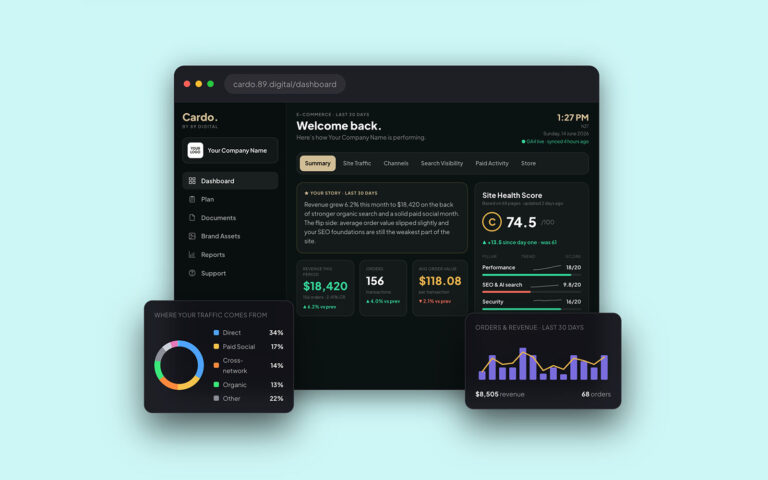
From GA4 to AI Search: How Cardo Simplifies Your Digital Strategy
Building and growing a digital presence should feel exciting—not like a daily chore. Yet for most business owners and marketing leaders, keeping tabs on performance means…
Read article →
Is your page builder costing your business?
Page builders are convenient, but a bloated website costs you in Google rankings, ad spend and lost conversions every single day.
Read article →