
Why Your Website Isn’t Ranking on Google (And How to Fix It)
Most small business owners know they should be doing SEO but don't know where to start. Here's what actually moves the needle when you're short on time and budget.
 By Hayley Fraser
Digital Strategist & Founder, 89 Digital Over 15 years experience in sales and marketing. Hayley works with business to build their website search visibility, AI readiness and digital strategy.
By Hayley Fraser
Digital Strategist & Founder, 89 Digital Over 15 years experience in sales and marketing. Hayley works with business to build their website search visibility, AI readiness and digital strategy.
Most small business owners know they should be doing SEO, but few really know what it is or where to start, and even fewer have the time to figure it out. Here are our recommendations on the actions that actually matter when you’re resource-limited and need results.
What SEO actually is – and isn’t
SEO — Search Engine Optimisation — is the practice of making your website show up when people search for what you offer online. That’s it.
It’s not magic, it’s not gaming the system, and it’s definitely not something you do once and forget about. It’s an ongoing process of making sure Google understands who you are, what you offer, and why you’re worth recommending.
The good news is that the bar isn’t that high for most small New Zealand businesses. Your competitors are often doing very little, which means even solid foundational SEO can move you up Google’s rankings faster than you’d expect.
Start with the basics for SEO
Make sure your foundations are solid before anything else.
- Your site needs to be fast. Google uses page speed as a ranking factor, and slow sites lose visitors. If your site takes more than three seconds to load on mobile, you’re losing people before they’ve read a word. Run your site through our free Website Audit and see where you sit.
- Your site needs to be mobile-friendly. On average 60% of searches happen on a phone. If your site is hard to navigate on mobile, Google notices — and so do your customers.
- Your site needs to be secure. An HTTPS padlock isn’t optional anymore. If your site still shows as “not secure” in the browser, fix that first — security can no longer be left behind.
- Your site needs to be set up with Google tools. Submitting your site to the free Google tools available, including Google Search Console and GA4, means you will start to gain data on indexing and search to build on over time.
What are my customers searching for?
The biggest mistake small business owners make with SEO is guessing what their customers are searching for.
A plumber in Auckland might assume people search for “plumbing services Auckland.” But they’re actually searching “emergency plumber Auckland” or “burst pipe Auckland” — very different pages. Tools like Cardo. by 89 Digital, or Google’s own search suggestions show you exactly what people are searching for. Search volume matters, but so does intent: someone searching “how to fix a leaky tap” probably won’t hire you, while someone searching “Plumber Birkenhead” absolutely might.
For most small businesses, local keywords are your best friend. “HR for small business” is a tough term to rank for globally. “HR for small business Auckland” or “HR consultant New Zealand” is much more achievable — and the person searching is far more likely to become a customer.
Website page content for SEO
Once you know which keywords you’re targeting, make sure each page is set up to rank for it. Each page should have one primary focus. Your homepage isn’t trying to rank for everything; your service pages each target a specific keyword; and your blog posts go after long-tail search terms.
The on-page elements that are a must for SEO are:
- Title tag — the blue link that appears in Google. Include your keyword and keep it under 60 characters.
- Meta description — the grey text below the title. It doesn’t directly affect rankings, but it affects whether people click, so make it compelling.
- H1 heading — the main heading on the page. It should match what you’re targeting.
- Content — write for humans first, Google second. Answer the question your customer is asking. Be specific, be useful. This also helps AI engines cite your business.
Google Business Profile — don’t skip this
If you serve customers in a specific area, your Google Business Profile is one of the most valuable things you can have. It’s free, and it’s what appears in the map results when someone searches locally. Fill it in completely, add photos, and collect reviews — and respond to them, good and bad. This alone can make a significant difference to local search visibility.
Does quality beat quantity, for website content?
You don’t need to publish three blog posts a week. You need to publish useful insights when you have something worth saying.
The best content for SEO answers a specific question your customer is already asking. “Why is my website so slow?” “How much does SEO cost in NZ?” “What’s the difference between SEO and Google Ads?” These are real questions with real search volume — and if you answer them well, Google will send people to you.
One solid, genuinely useful article a month will outperform five thin, generic ones every time.
Does website linking still matter?
When other websites link to yours, Google takes it as a signal that you’re credible — and the more authoritative the site linking to you, the stronger the signal.
For small businesses, the best way to build links isn’t an elaborate outreach strategy — it’s doing things worth linking to: getting listed in industry directories, contributing to local publications, being mentioned in a media article, or having suppliers and partners reference you. You don’t need hundreds of links. A handful of genuinely relevant ones from credible New Zealand sites will make a real difference.
How do I find out what people are searching for?
If you’re not measuring, you’re guessing. The two tools you need are Google Analytics (to understand how people behave on your site) and Google Search Console (to see what searches bring people to you, and how you’re ranking). Look at:
- Which pages are getting traffic from search
- Which keywords are bringing people in
- Where you’re ranking for your target terms
- How your traffic changes month on month
Set aside 30 minutes a month to check these. That’s enough to know whether things are moving in the right direction.
The truth
SEO takes time. If someone’s promising you page-one results in two weeks, they’re either lying or about to do something that’ll get your site penalised.
A realistic timeline is three to six months before you see meaningful movement, and six to twelve before SEO becomes a reliable traffic source. The businesses that win at SEO are the ones that treat it as an ongoing investment, not a one-time fix.
If you’d rather focus on running your business and have someone else handle the strategy, measurement and monthly optimisation, that’s exactly what our Growth Plan is built for. Every client gets Cardo., our reporting platform, so you always know exactly what your SEO is returning.
Grow it, month after month.
Market your website and grow your traffic and sales — managed month by month, with clear reporting.
Learn about Growth →Get the next Insight
Keep up to date with the latest thinking from 89 Digital. From website performance and AI search to tips for growing your business online.
Keep reading

WooCommerce vs Shopify: 10 Reasons Growing Stores Choose to Own, Not Rent
If you’re starting an online store, or wondering whether your current one still suits you, two names come up first: WooCommerce and Shopify. Both are capable…
Read article →
10 signs your WooCommerce store is losing sales
Most WooCommerce stores don’t fail all at once. They leak: a slower page here, a lost order email there, a shipping rate that quietly costs you…
Read article →
Why Your Google Ads Aren’t Converting: The Hidden WooCommerce Glitches Draining Your Budget
You’re spending money on Google Ads to bring targeted buyers to your WooCommerce store. The traffic is arriving, the clicks are showing in your dashboard, but…
Read article →
Your Website Is Getting Attacked Right Now (And You Don’t Even Know It)
Most business owners assume that a cyber attack is loud and obvious. They picture a defaced homepage, a sudden black screen, or a site crashing entirely.…
Read article →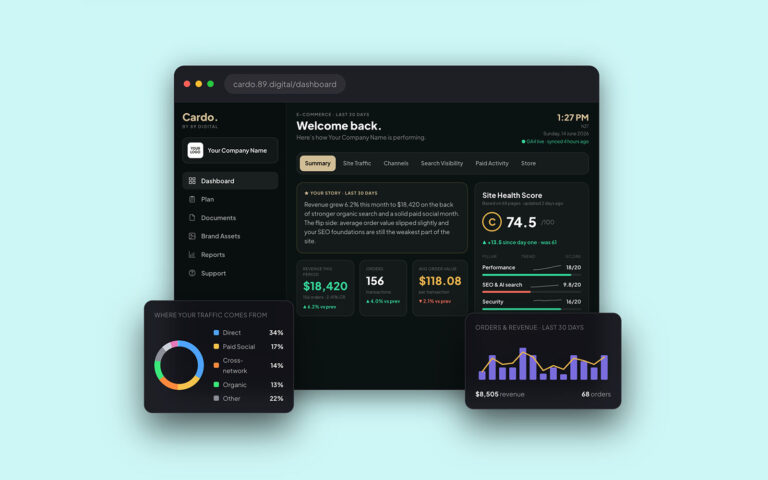
From GA4 to AI Search: How Cardo Simplifies Your Digital Strategy
Building and growing a digital presence should feel exciting—not like a daily chore. Yet for most business owners and marketing leaders, keeping tabs on performance means…
Read article →
Is your page builder costing your business?
Page builders are convenient, but a bloated website costs you in Google rankings, ad spend and lost conversions every single day.
Read article →
The compound effect: how a Growth Plan builds momentum month by month
Month one looks quiet. Month six looks very different. Here's how a Growth retainer creates compounding returns over time.
Read article →